

Understanding distance conversions is essential in many fields, especially in navigation, aviation, and maritime travel. One of the most commonly searched conversions is 1 nautical mile to km, and knowing how to calculate it accurately can save time and improve understanding. In this comprehensive guide, you will learn the exact value, the logic behind the conversion, and practical methods to calculate it بسهولة and accurately.
What Is 1 Nautical Mile to KM?
The most important fact to remember is simple:
1 nautical mile to km equals 1.852 kilometers.
A nautical mile is a unit of measurement used primarily in sea and air navigation. Unlike a standard mile, which is based on land measurement, a nautical mile is based on the Earth’s geometry. It represents one minute of latitude, making it extremely useful for global navigation.
This precise definition ensures consistency when calculating distances across oceans and air routes. When converting 1 nautical mile to km, you are simply translating this geographic measurement into the metric system.
Why Nautical Miles Are Different from Kilometers
To fully understand 1 nautical mile to km, it is important to know why nautical miles exist in the first place. The Earth is round, and navigation depends on coordinates such as latitude and longitude.
A nautical mile is directly tied to the Earth’s circumference. One nautical mile equals one minute of latitude, which makes calculations on maps much easier for pilots and sailors.
Kilometers, on the other hand, are part of the metric system and are used worldwide for everyday measurements. While kilometers are practical for land distances, nautical miles provide better accuracy for navigation.
This difference is why the conversion of 1 nautical mile to km is widely used in global industries.
Easy Formula for Converting Nautical Miles to Kilometers
The conversion process is very simple. You only need one formula:
Kilometers = Nautical Miles × 1.852
Using this formula, converting 1 nautical mile to km becomes:
1 × 1.852 = 1.852 km
This formula works for any value. For example:
5 nautical miles = 5 × 1.852 = 9.26 km
10 nautical miles = 10 × 1.852 = 18.52 km
By remembering this multiplication factor, you can quickly convert any nautical distance into kilometers without needing complex tools.
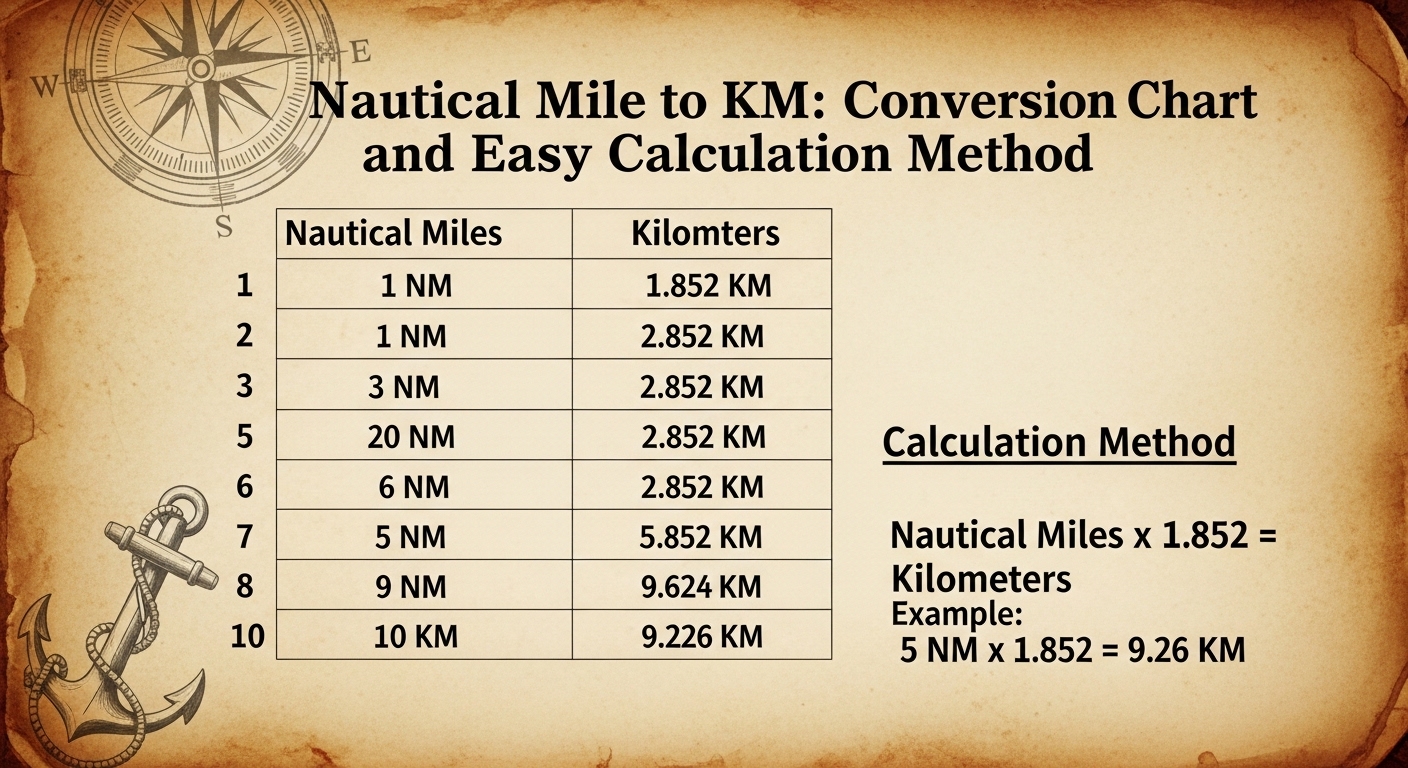
1 Nautical Mile to KM Conversion Chart
To make things easier, here is a quick reference chart for common conversions related to 1 nautical mile to km:
1 nautical mile = 1.852 km
2 nautical miles = 3.704 km
3 nautical miles = 5.556 km
5 nautical miles = 9.26 km
10 nautical miles = 18.52 km
20 nautical miles = 37.04 km
50 nautical miles = 92.6 km
100 nautical miles = 185.2 km
This chart helps you quickly estimate distances without performing calculations every time. It is especially useful for students, travelers, and professionals.
Practical Uses of Nautical Mile to KM Conversion
The conversion of 1 nautical mile to km is not just theoretical. It has many real-world applications.
In aviation, pilots use nautical miles to measure flight distances and speed. Aircraft speed is often measured in knots, which are based on nautical miles per hour.
In maritime navigation, ships rely on nautical miles to calculate distances across oceans. Since maps and charts are designed using latitude and longitude, nautical miles provide accurate positioning.
Even in education, students studying geography or physics learn about 1 nautical mile to km as part of understanding global measurement systems.
Additionally, weather forecasting and oceanography also use nautical miles to measure distances and track movements across the Earth.
Why the Exact Value Is 1.852 KM
The value of 1 nautical mile to km is not random. It is derived from the Earth’s circumference.
The Earth is divided into 360 degrees, and each degree is further divided into 60 minutes. One minute of latitude equals one nautical mile.
When scientists calculated the Earth’s circumference in metric units, they determined that one minute of latitude equals approximately 1.852 kilometers.
This precise measurement ensures consistency across all navigation systems worldwide.
Step-by-Step Calculation Method
If you want to convert nautical miles manually, follow these simple steps:
First, identify the number of nautical miles you want to convert.
Second, multiply that number by 1.852.
Third, write the result in kilometers.
For example, if you want to convert 7 nautical miles:
7 × 1.852 = 12.964 km
This step-by-step method ensures accuracy and helps you understand the process clearly.
Common Mistakes to Avoid
When working with 1 nautical mile to km, people often make simple mistakes.
One common mistake is confusing nautical miles with regular miles. A land mile is equal to 1.609 kilometers, which is different from a nautical mile.
Another mistake is rounding too early. Always use the full value 1.852 for better accuracy.
Some people also forget the multiplication factor and try to estimate the value, which can lead to incorrect results.
By understanding these common errors, you can avoid confusion and perform accurate conversions.
Benefits of Learning This Conversion
Knowing how to convert 1 nautical mile to km offers several advantages.
It improves your understanding of global measurement systems.
It helps in travel planning, especially for sea and air journeys.
It enhances your knowledge in geography and science.
It allows quick mental calculations without relying on tools.
This knowledge is especially useful for students, professionals, and anyone interested in navigation or travel.
Conclusion
Understanding 1 nautical mile to km is simple yet highly valuable. The exact conversion is 1 nautical mile equals 1.852 kilometers, and this value is used worldwide in aviation, maritime navigation, and scientific studies.
By learning the formula and practicing with the conversion chart, you can easily convert nautical miles into kilometers without any confusion. Whether you are a student, traveler, or professional, mastering this conversion will enhance your practical knowledge and accuracy.