

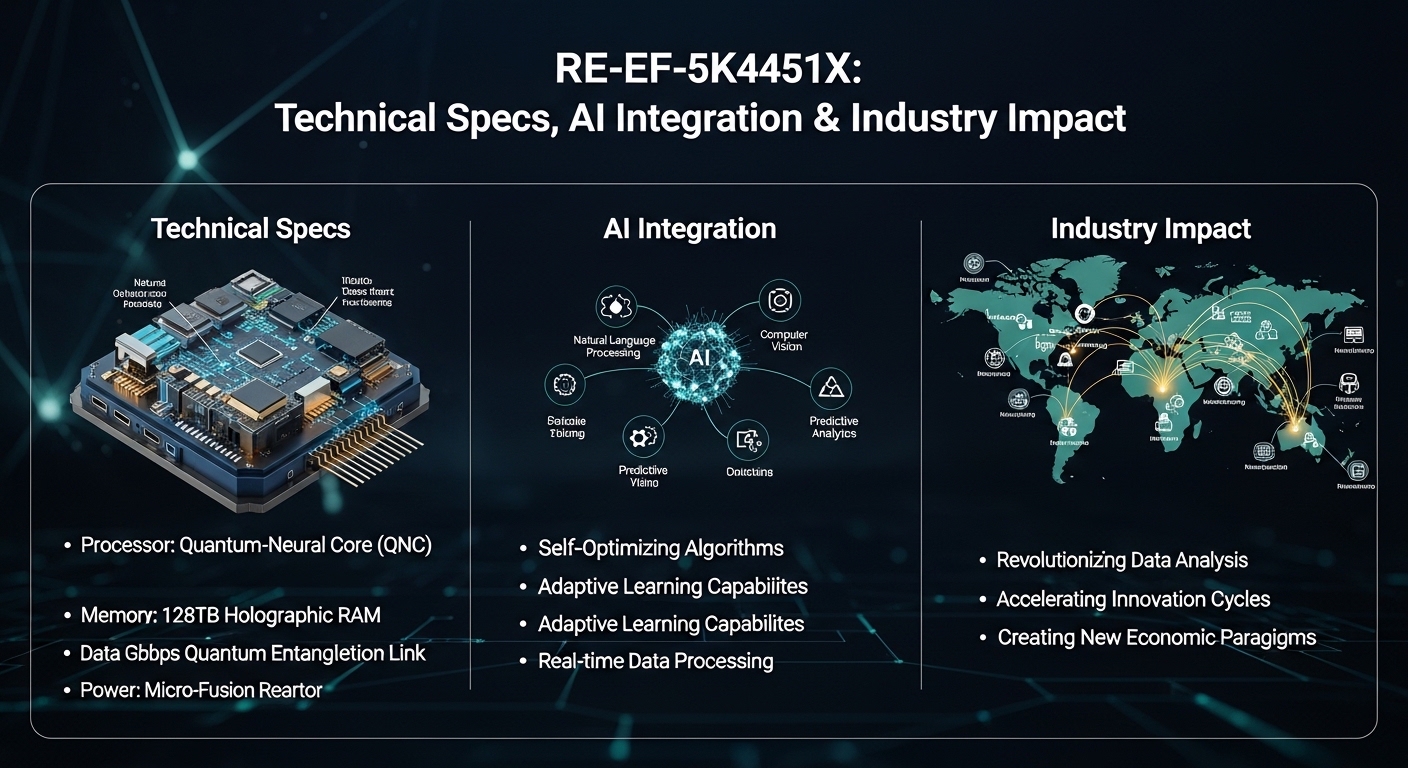
RE-EF-5K4451X Technical Specs, AI Integration & Industry Impact is rapidly becoming a reference model for organizations seeking intelligent, scalable, and future-ready digital infrastructure. Designed as a high-performance, AI-native processing platform, this advanced system blends real-time analytics, adaptive automation, and industrial-grade reliability into a unified architecture. As enterprises move toward autonomous operations and data-driven decision frameworks, this solution stands out as a strategic technology layer rather than a single-purpose device.
This in-depth guide explores its complete technical specifications, its built-in artificial intelligence framework, and the wider transformation it is bringing to modern industries. The goal is to offer a clear, practical, and SEO-friendly overview for technology leaders, system architects, and innovation teams evaluating next-generation intelligent platforms.
Understanding the Vision Behind RE-EF-5K4451X
RE-EF-5K4451X was created to bridge the widening gap between traditional high-performance computing and AI-centric operational models. While conventional platforms focus mainly on raw processing speed, this system is engineered around adaptive intelligence, dynamic optimization, and seamless edge-to-cloud integration.
The core philosophy centers on three strategic pillars. The first is continuous learning, allowing the system to evolve with operational data. The second is interoperability, ensuring it can integrate smoothly with legacy environments and modern cloud frameworks. The third is operational resilience, enabling consistent performance under demanding industrial conditions.
This design approach positions the platform not merely as a hardware unit or software stack, but as a modular intelligence engine that supports digital transformation initiatives across multiple sectors.
Architectural Design and System Framework
At the architectural level, RE-EF-5K4451X uses a layered processing framework that separates core compute tasks, AI inference workloads, and orchestration services into independently scalable modules. This structure allows organizations to expand processing or intelligence layers without disrupting live operations.
The hardware abstraction layer manages real-time data streams, sensor feeds, and machine interfaces. Above it, a virtualization layer distributes workloads intelligently between CPU, GPU, and AI accelerators. At the top of the stack, an adaptive orchestration engine handles task prioritization, predictive resource allocation, and fault-tolerant execution.
This multi-tiered structure dramatically improves system stability while supporting high concurrency and low-latency processing demands.
Core Technical Specifications Overview
The internal computing engine of RE-EF-5K4451X is optimized for mixed-precision workloads, allowing both high-accuracy and high-throughput operations to coexist efficiently. The platform supports heterogeneous processing units that dynamically share workloads depending on data type, execution urgency, and energy efficiency constraints.
Its memory architecture features unified high-bandwidth memory pools that reduce data movement between processing layers. This significantly lowers latency and improves training and inference performance for machine learning workloads.
Storage architecture is designed around hybrid NVMe and persistent memory technology, enabling extremely fast access to training datasets, digital twins, and operational models. Network connectivity is supported through multi-channel low-latency interfaces, making it suitable for both centralized data centers and distributed edge deployments.
Thermal management and power efficiency have also been carefully engineered. Intelligent cooling algorithms adjust system performance in real time, maintaining optimal operating conditions while minimizing energy waste.
Compute Performance and Scalability
RE-EF-5K4451X delivers highly predictable performance even under complex workloads such as real-time simulation, video analytics, autonomous system coordination, and advanced robotics control.
The platform’s internal scheduler continuously analyzes task profiles and dynamically distributes processing loads across available compute resources. This eliminates traditional bottlenecks caused by static allocation models.
Horizontal scalability allows multiple units to operate as a unified processing cluster. Vertical scalability enables the expansion of compute and memory modules within a single system. This dual-scaling model allows enterprises to start with modest deployments and gradually expand capacity as operational needs evolve.
Built-In AI Acceleration Capabilities
A defining feature of RE-EF-5K4451X is its integrated AI acceleration layer. This layer supports deep neural network inference, reinforcement learning loops, and real-time anomaly detection without requiring external accelerators.
The AI engine includes specialized processing cores optimized for tensor operations, sparse matrix calculations, and attention-based models. This design ensures consistent performance for modern AI workloads such as computer vision, natural language processing, and predictive analytics.
The system supports both pre-trained models and custom training pipelines. Organizations can deploy proprietary models while maintaining full control over data governance and optimization strategies.
AI Integration Architecture and Workflow
The AI integration framework of RE-EF-5K4451X is structured around a model-centric workflow. Data ingestion pipelines automatically preprocess and normalize incoming data streams before routing them to appropriate training or inference modules.
Model lifecycle management is built directly into the orchestration layer. This allows continuous monitoring of model accuracy, performance drift, and inference reliability. When performance degradation is detected, the system can initiate retraining cycles using newly collected data.
This closed-loop intelligence architecture transforms traditional static AI deployments into living systems that continuously adapt to operational changes.
Adaptive Learning and Autonomous Optimization
One of the most valuable capabilities of RE-EF-5K4451X is its autonomous optimization engine. Rather than relying solely on predefined operational rules, the system learns from historical performance data and real-time telemetry.
By applying reinforcement learning techniques, it discovers optimal scheduling patterns, energy consumption strategies, and resource allocation profiles. Over time, this reduces operational costs and increases throughput without manual intervention.
The learning framework is transparent and auditable, allowing engineering teams to review decision paths, model behaviors, and optimization outcomes.
Security, Compliance, and Data Protection
Security is deeply embedded in the platform’s architecture. Hardware-level trust anchors ensure secure boot processes and verified firmware integrity. All data streams can be encrypted both at rest and in motion using enterprise-grade cryptographic standards.
AI models and training datasets are protected through isolated execution environments. This prevents unauthorized access to proprietary algorithms and sensitive operational data.
Compliance frameworks support industry standards for data protection, operational traceability, and regulatory audits. Built-in logging and monitoring services provide full visibility into system activity, model usage, and configuration changes.
Edge-to-Cloud Deployment Flexibility
RE-EF-5K4451X has been engineered for seamless deployment across centralized data centers, industrial edge environments, and hybrid cloud infrastructures.
At the edge, the platform delivers ultra-low-latency inference for applications such as machine vision inspection, autonomous vehicle coordination, and smart infrastructure management. In cloud-connected scenarios, it supports large-scale model training, global analytics aggregation, and enterprise reporting services.
This unified deployment model eliminates the traditional separation between operational technology and enterprise IT environments.
Integration with Existing Enterprise Systems
A major advantage of RE-EF-5K4451X is its extensive interoperability layer. The platform provides native support for industrial communication protocols, enterprise service buses, and modern API frameworks.
Legacy systems can be integrated without major reengineering projects. Real-time data can be ingested from programmable controllers, manufacturing execution systems, and logistics platforms, allowing organizations to build AI-driven workflows on top of their existing digital infrastructure.
This significantly reduces adoption barriers and accelerates return on investment.
Industrial and Commercial Use Cases
In advanced manufacturing environments, RE-EF-5K4451X enables predictive maintenance by analyzing equipment telemetry and identifying early indicators of mechanical failure. Production lines benefit from adaptive scheduling that responds instantly to material shortages or quality issues.
In logistics and supply chain operations, the platform supports demand forecasting, route optimization, and inventory intelligence using real-time data from distributed facilities.
In energy and utilities, the system manages grid optimization, predictive load balancing, and fault detection across large-scale infrastructure networks.
Healthcare research and life sciences organizations use the platform to process large biomedical datasets, support AI-driven diagnostics research, and accelerate computational modeling.
Financial services deploy RE-EF-5K4451X to perform high-speed risk analysis, fraud detection, and algorithmic trading simulations while maintaining strict regulatory compliance.
Transforming Operational Intelligence
The broader impact of RE-EF-5K4451X lies in its ability to transform operational intelligence into a continuous strategic capability. Instead of relying on periodic reports or manual analytics cycles, organizations gain persistent situational awareness powered by live data and adaptive models.
This shift enables faster decision cycles, improved operational resilience, and more accurate forecasting. Executives gain clearer visibility into performance drivers, while operational teams receive automated recommendations optimized for real-world conditions.
Industry Impact and Market Influence
The introduction of RE-EF-5K4451X reflects a broader industry movement toward autonomous enterprise platforms. Traditional IT infrastructure is increasingly unable to meet the demands of AI-driven operations, particularly in sectors where real-time decisions directly affect safety, quality, and profitability.
By combining high-performance computing, embedded AI, and operational orchestration in a single platform, this solution sets a new benchmark for intelligent infrastructure systems.
Its influence is accelerating the convergence of data engineering, AI operations, and industrial automation into unified digital ecosystems. Vendors, integrators, and solution providers are now aligning their development strategies around similar intelligence-first architectures.
Economic and Organizational Benefits
Organizations adopting RE-EF-5K4451X typically experience measurable improvements in operational efficiency, asset utilization, and energy consumption. Automated optimization reduces the need for manual configuration and reactive troubleshooting.
From an organizational perspective, teams benefit from simplified system management and reduced technical complexity. Engineers can focus on model innovation and process improvement rather than infrastructure maintenance.
The platform also supports long-term workforce development by enabling data scientists, process engineers, and IT teams to collaborate within a shared intelligence environment.
Long-Term Scalability and Future Readiness
Future readiness is a central design goal of RE-EF-5K4451X. Its modular architecture allows emerging AI accelerators, memory technologies, and networking standards to be incorporated without requiring a full system replacement.
The platform is also prepared for upcoming AI workloads such as multimodal reasoning, generative simulation, and collaborative agent systems. Its orchestration engine can already coordinate multiple AI agents operating concurrently across distributed environments.
This ensures that organizations investing in the platform today remain well positioned as artificial intelligence technologies continue to evolve.
Implementation Strategy and Deployment Planning
Successful implementation of RE-EF-5K4451X begins with a clear assessment of operational objectives, data availability, and integration requirements. Organizations typically start by deploying the platform in a limited operational domain to validate model performance and workflow compatibility.
Once baseline performance metrics are established, additional workloads and data sources can be integrated incrementally. This phased approach reduces risk while allowing teams to develop internal expertise in AI operations and intelligent system management.
Training programs for technical staff further enhance adoption success by enabling teams to fully leverage model lifecycle tools, optimization engines, and orchestration capabilities.
Governance, Transparency, and Ethical AI
The platform supports responsible AI practices through built-in model explainability, audit trails, and bias monitoring tools. Decision outputs can be traced back to model inputs, training datasets, and optimization parameters.
This transparency is essential in regulated industries and mission-critical environments where automated decisions must be verifiable and accountable.
Governance policies can be enforced across model deployment pipelines, ensuring that only validated and approved models are promoted to production environments.
Conclusion
RE-EF-5K4451X represents a new generation of intelligent infrastructure designed for organizations that view artificial intelligence as a foundational operational capability rather than a supplementary technology. By combining powerful technical specifications, deeply integrated AI frameworks, and enterprise-ready security and governance, the platform enables continuous optimization and adaptive intelligence across diverse industries.
Its ability to unify compute performance, learning systems, and orchestration workflows within a scalable and resilient architecture positions it as a strategic enabler for digital transformation. As industries continue to move toward autonomous operations and real-time decision ecosystems, RE-EF-5K4451X stands as a forward-looking platform capable of supporting innovation, efficiency, and sustainable growth for years to come.