

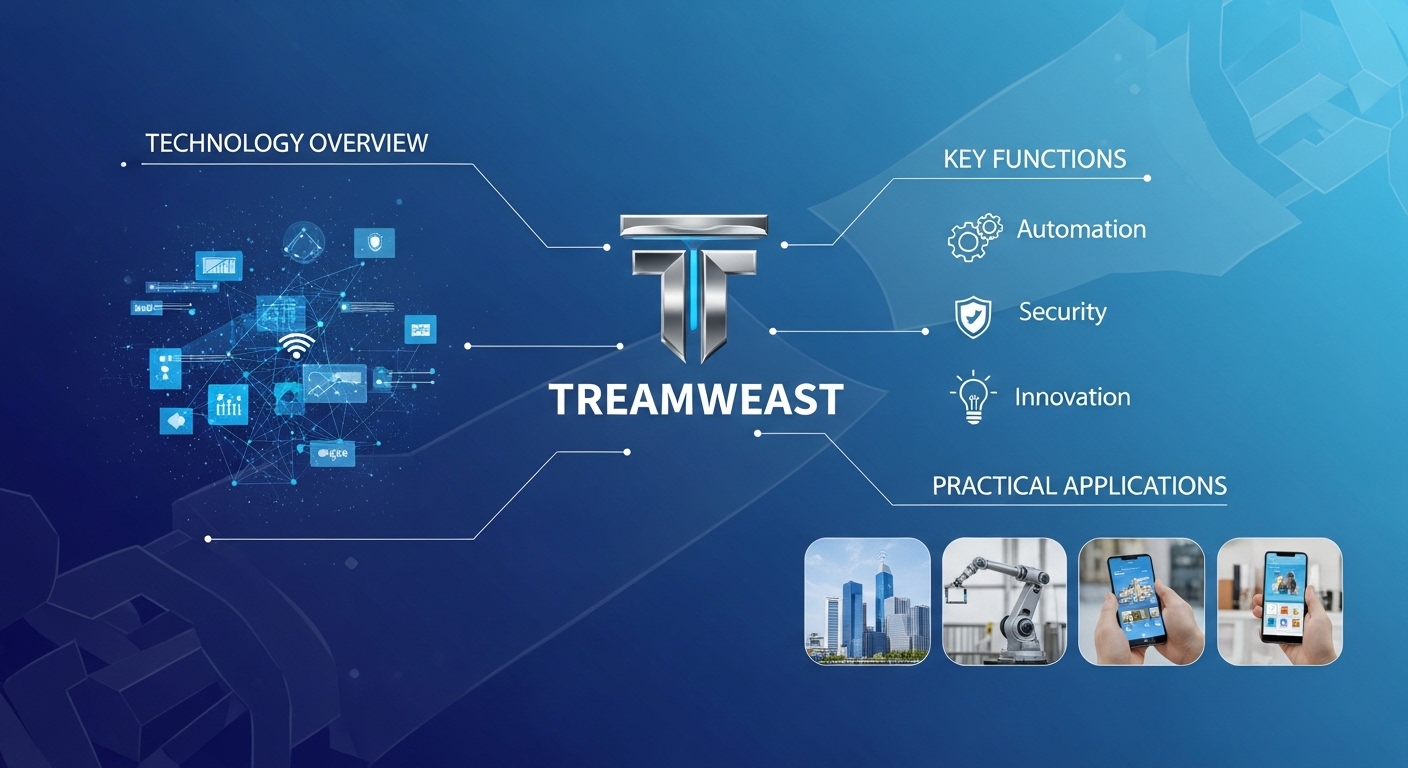
Treamweast Technology Overview Key Functions and Practical Applications is rapidly emerging as a powerful digital framework designed to help modern organizations manage data, workflows, and intelligent automation within one unified ecosystem. As companies face growing pressure to become more agile, secure, and customer-focused, Treamweast offers a structured yet flexible technology environment that supports innovation without adding operational complexity. This in-depth guide explores how the platform works, what makes it different from conventional enterprise tools, and how real-world businesses can use it to improve performance, decision making, and digital resilience.
Understanding the Purpose of Treamweast in Modern Technology
Treamweast was created to address a common challenge faced by growing organizations: disconnected systems that slow productivity and make data difficult to use. Traditional software environments often rely on multiple platforms for analytics, workflow management, system monitoring, and automation. Treamweast brings these capabilities together into a single operational layer that connects people, data, and processes.
At its core, Treamweast is designed to function as a smart orchestration platform. It links operational systems, digital services, and data sources through an intelligent control structure that simplifies coordination between teams and technologies. Instead of building complex integrations manually, organizations can use the built-in architecture of Treamweast to standardize communication across applications and automate routine actions.
The technology is especially valuable in industries where speed, accuracy, and compliance are essential. From digital operations teams to enterprise IT departments and innovation leaders, the platform provides a consistent foundation for building scalable digital solutions.
Core Architecture and Technology Framework
The internal architecture of Treamweast is based on a modular design. Each function is delivered as an independent service that can operate alone or as part of a larger workflow. This structure allows organizations to deploy only what they need and expand capabilities as business requirements evolve.
A central orchestration engine coordinates data exchange, automation logic, and system events. This engine monitors activity across connected platforms and triggers predefined actions whenever certain conditions are met. The result is a responsive digital environment that adapts to operational changes in real time.
The platform also incorporates a flexible data layer that supports structured and unstructured information. This makes it possible to analyze customer data, system logs, performance metrics, and business intelligence within a single operational context. Treamweast ensures that data flows remain secure, traceable, and compliant with enterprise governance standards.
Cloud compatibility is another key element of the framework. Treamweast is designed to run across hybrid and multi-cloud environments, enabling organizations to integrate on-premise systems with cloud services without re-architecting their entire infrastructure.
Key Functional Capabilities of Treamweast
The functional strength of Treamweast lies in its ability to unify complex digital activities under a simplified operational model. One of the primary capabilities is intelligent workflow automation. Business processes can be modeled visually and enhanced with conditional logic that responds dynamically to real-time inputs.
Another essential function is system integration management. The platform includes a library of connectors and integration templates that reduce the technical effort required to connect applications, databases, and services. These integrations are managed centrally, providing better visibility into data flows and system dependencies.
Advanced monitoring and observability tools are also built into the platform. Treamweast continuously tracks system performance, operational bottlenecks, and data processing activity. This allows teams to identify inefficiencies early and resolve issues before they impact users or customers.
Security and access management form another important layer of functionality. The platform enforces role-based permissions, activity logging, and policy-driven data handling. This ensures that sensitive business information remains protected while still being accessible to authorized users.
Intelligent Automation and Decision Support
One of the most valuable aspects of Treamweast is its support for intelligent automation. Instead of relying solely on rule-based triggers, the platform can incorporate predictive logic and adaptive models to support more advanced decision workflows.
For example, operational data can be analyzed continuously to detect patterns that indicate system overload, customer churn risk, or supply chain disruption. When such patterns appear, Treamweast can automatically launch corrective actions such as reallocating resources, notifying relevant teams, or adjusting service parameters.
Decision support dashboards provide managers with real-time visibility into business performance. These dashboards combine operational metrics with analytical insights, allowing leaders to move from reactive management to proactive planning. The result is a digital environment where data actively supports strategic outcomes rather than remaining isolated in reporting tools.
Data Management and Analytics Integration
Effective data utilization is a cornerstone of digital transformation. Treamweast provides an integrated approach to data ingestion, transformation, and analysis that simplifies the entire data lifecycle.
Incoming data from multiple systems is standardized through configurable pipelines. These pipelines clean, enrich, and validate data before it becomes available for analytics or automation workflows. This reduces errors and improves the reliability of business insights.
Analytics tools within the platform allow teams to perform trend analysis, operational forecasting, and performance optimization without exporting data to external systems. By keeping data processing close to operational workflows, organizations can shorten the time between insight and action.
The platform also supports external analytics environments, enabling advanced data science teams to integrate their models into live operational processes. This allows predictive and prescriptive insights to influence real-world decisions in near real time.
Practical Applications Across Business Domains
Treamweast is not limited to a single industry or use case. Its flexibility allows organizations to apply the technology across a wide range of operational scenarios.
In enterprise IT operations, the platform can automate incident response, system provisioning, and configuration management. When infrastructure metrics indicate potential failures, automated remediation workflows can be launched to restore services with minimal human intervention.
In customer experience management, Treamweast can coordinate data from customer relationship systems, digital engagement platforms, and service channels. This unified view enables organizations to personalize interactions, resolve issues faster, and continuously improve service quality.
Manufacturing and logistics operations can use the platform to monitor production data, inventory levels, and supply chain activity. Automated workflows help align procurement, scheduling, and quality control processes, reducing delays and improving operational transparency.
In financial operations, the platform supports compliance monitoring, transaction validation, and risk management workflows. Automated alerts and approval processes help ensure that regulatory requirements are met while minimizing administrative overhead.
Supporting Digital Transformation Strategies
Digital transformation is not only about adopting new tools but also about changing how organizations operate. Treamweast supports this transformation by enabling continuous process optimization and cross-functional collaboration.
Business and technical teams can jointly design workflows that reflect real operational needs. Visual modeling tools make it easier for non-technical stakeholders to participate in process design, improving alignment between strategy and execution.
The platform also enables organizations to experiment with new digital services without disrupting existing operations. New workflows and integrations can be deployed in controlled environments, tested with real data, and scaled gradually as confidence grows.
This approach reduces transformation risk while encouraging innovation. Teams gain the freedom to explore new service models, automation scenarios, and data strategies within a stable governance framework.
Scalability and Performance Optimization
As organizations grow, their digital infrastructure must scale efficiently. Treamweast is built to support increasing transaction volumes, expanding data sets, and growing numbers of users without degrading performance.
The modular architecture allows individual components to be scaled independently. High-volume automation processes can be optimized separately from analytics workloads or user interfaces. This flexibility helps organizations allocate resources precisely where they are needed.
Performance optimization tools provide insight into processing latency, system throughput, and workflow execution times. These metrics enable continuous tuning of platform configurations and automation logic to maintain responsiveness even during peak demand periods.
The platform’s cloud-ready design also enables dynamic resource provisioning. Organizations can scale compute and storage capacity based on operational requirements, avoiding unnecessary infrastructure costs.
Governance, Compliance, and Operational Transparency
Strong governance is essential in complex digital environments. Treamweast includes built-in mechanisms that support regulatory compliance, operational accountability, and audit readiness.
Every workflow execution, data transformation, and system interaction is logged automatically. These activity records provide a clear audit trail that supports internal reviews and external regulatory requirements.
Policy management features allow organizations to define how data is accessed, processed, and retained. Automated enforcement ensures that governance rules are applied consistently across all workflows and integrations.
Operational transparency is further enhanced through reporting tools that provide insights into workflow performance, user activity, and system health. This visibility supports better decision making and helps organizations maintain trust with customers, partners, and regulators.
Implementation Approach and Organizational Readiness
Successful deployment of Treamweast begins with a clear understanding of organizational objectives. Rather than attempting to automate every process at once, most organizations benefit from starting with high-impact workflows that demonstrate immediate value.
A phased implementation strategy allows teams to refine integration models, security configurations, and operational standards before scaling the platform across additional departments. Training and change management are equally important. Users must understand not only how to use the platform but also how automation and data-driven workflows change daily operations.
Executive sponsorship and cross-departmental collaboration further strengthen adoption. When leadership actively supports digital process transformation, teams are more willing to embrace new operational models and participate in continuous improvement initiatives.
Future Outlook and Innovation Potential
The long-term value of Treamweast lies in its adaptability. As emerging technologies such as advanced artificial intelligence, real-time analytics, and intelligent edge computing become more mainstream, the platform can integrate these capabilities without disrupting existing workflows.
Organizations can progressively enhance automation logic with more advanced predictive models and adaptive decision frameworks. This enables a shift from task automation to outcome-driven operations, where systems actively optimize performance based on evolving business goals.
The platform also positions organizations to participate more effectively in digital ecosystems. By simplifying integration and data exchange, Treamweast supports collaboration with partners, service providers, and digital marketplaces, expanding opportunities for innovation and growth.
Conclusion
Treamweast: Technology Overview Key Functions and Practical Applications clearly demonstrates how a unified digital platform can reshape the way organizations manage operations, data, and automation in today’s fast-moving business environment. By combining intelligent workflow orchestration, real-time analytics, secure system integration, and scalable cloud-ready architecture, Treamweast enables enterprises to move beyond disconnected tools and fragmented processes.